Origin Story
Born From the Fight
The Concealed Carriers Union was not created in a boardroom. It was born from a fight with the administrative gun-control machine.
A fight over permits.
A fight over sheriff power.
A fight over private associations using public authority.
A fight over whether concealed carriers would keep standing alone or finally organize.
The Origin
Nevada's Most Successful CCW Instructor Exposed the System by Outgrowing It
Before the Concealed Carriers Union existed, there was Vegas CCW.
Nephi Khaliki built one of the most successful concealed-carry training operations in Nevada. His classes were not small, quiet, back-room courses. They were large-format, record-setting CCW events.
People wanted training. People wanted permits. People wanted to exercise their rights. And they would show up by the thousands when someone removed the barriers, lowered the cost, and treated concealed carry like a right instead of a privilege.
Vegas CCW became proof of demand. Proof that concealed carriers were not isolated. Proof that, if organized, they could become a force.
The problem was not that people were breaking the law. The problem was that too many people were successfully using the law.
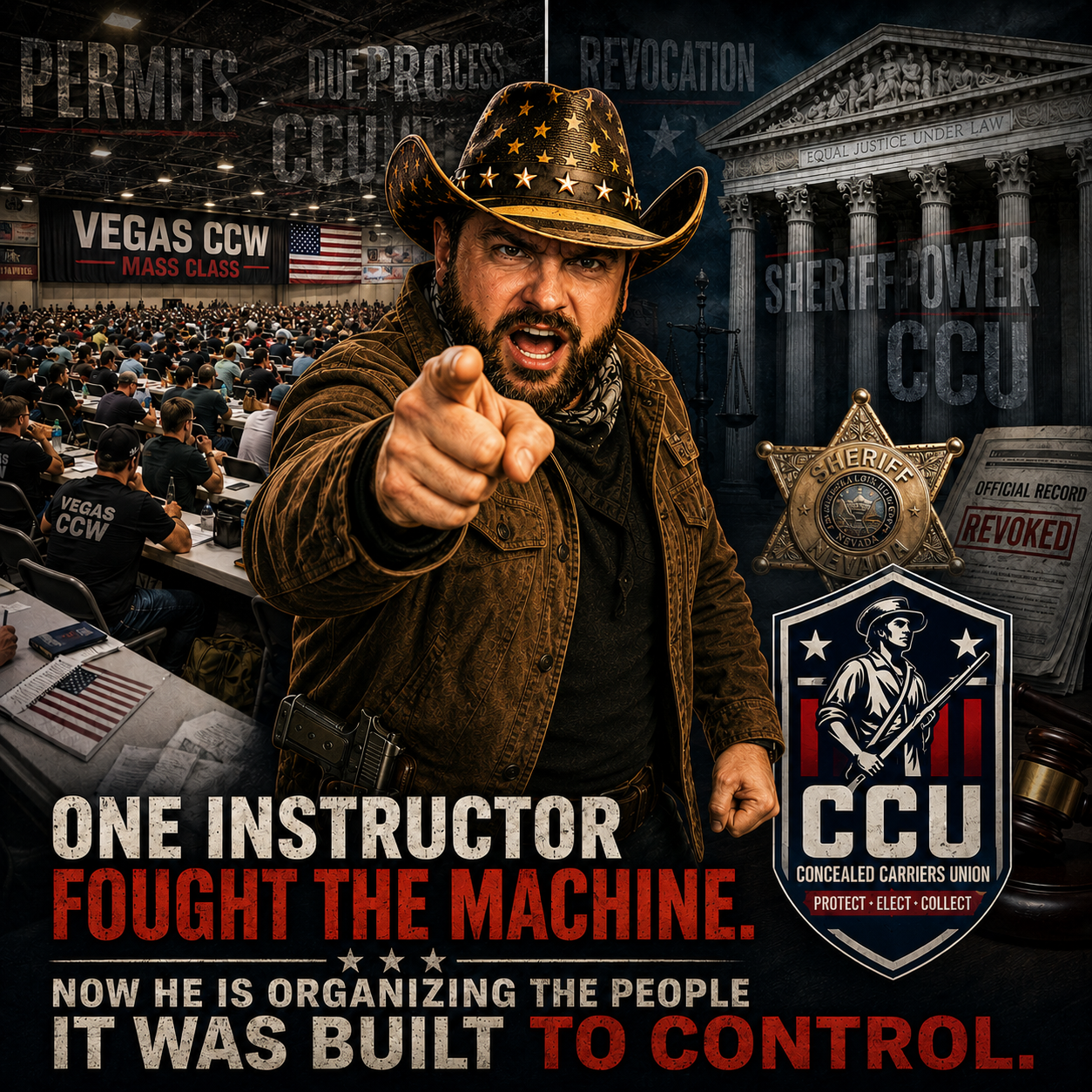
Large Classes Were Allowed - Until They Became Too Successful
Khaliki learned early that large-format CCW classes were allowable. The issue was not whether people could be trained at scale. The issue was control.
When Vegas CCW began holding massive classes, the administrative pressure started. Classes were challenged. Approvals were questioned. Credentials were attacked. Processes shifted. Reasons changed. Technical objections appeared.
What looked like ordinary bureaucracy began to look like a system that tolerated concealed carry only so long as it remained slow, expensive, scattered, and easy to manage.
The Fight Escalated
The Fight Was Never Just About One Instructor
At first, the fight looked personal. One instructor. One sheriff's department. One class. One approval. One revocation. One appeal.
But after repeated battles, Khaliki began to see that the issue was much larger. The problem was structural.
Who had authority to regulate instructors? Who had authority to revoke approval? Was there a real hearing? Was there a neutral adjudicator?
Khaliki sued again and again until the fight forced LVMPD and the Nevada Sheriffs' and Chiefs' Association into federal court to answer for the administrative scheme.
A lawsuit can expose the machine. A union can fight it everywhere.
Administrative Gun Control Was the Real Enemy
Khaliki discovered that the greatest threat to gun rights was not always the law passed in public. Sometimes the real threat came later.
Through administration. Through forms. Through policies. Through delays. Through renewals. Through technicalities. Through hidden standards. Through private committees. Through sheriff associations. Through vague letters.
That is Administrative Gun Control. It is how government turns rights into paperwork.
No concealed carrier should have to face it alone.
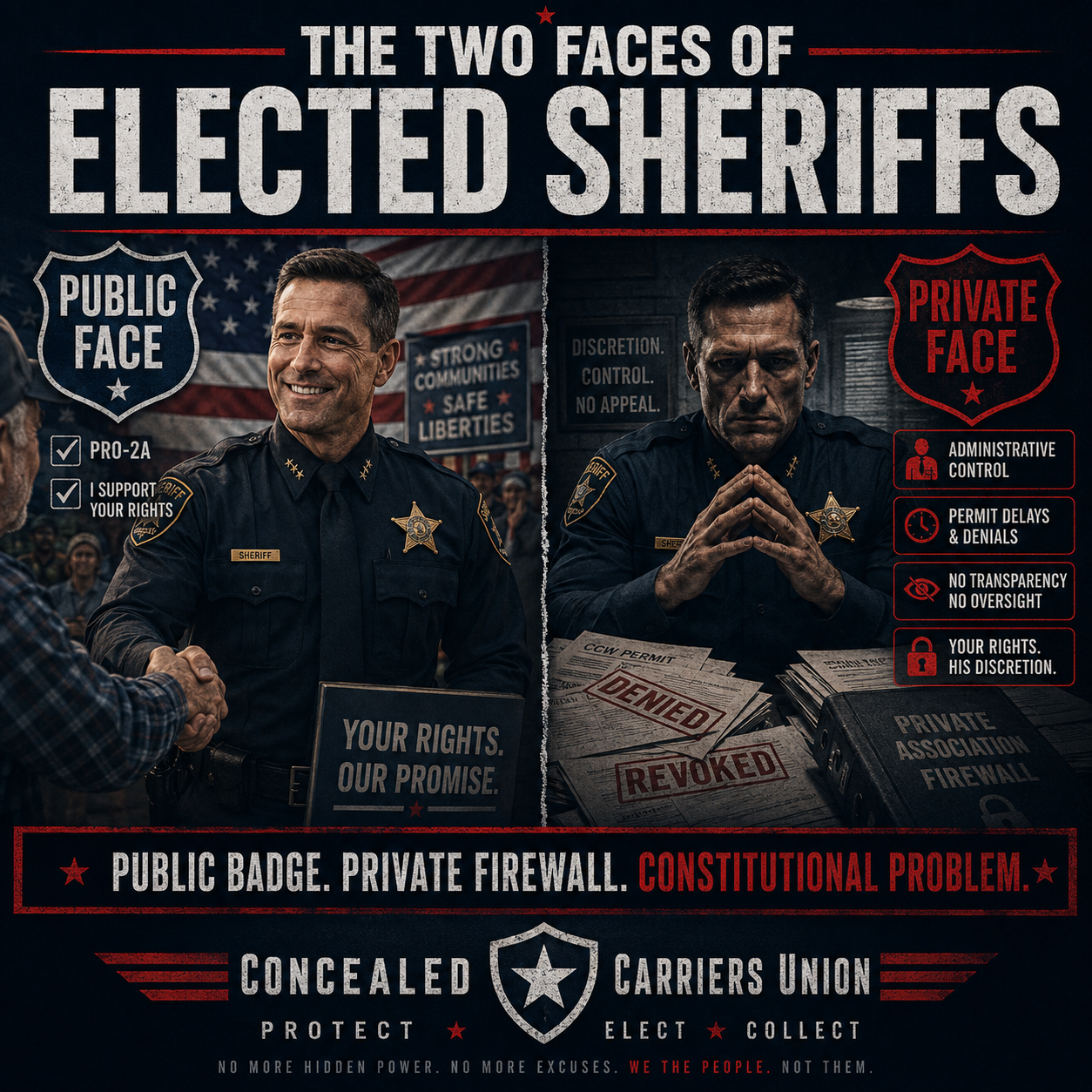
Public Power. Private Firewall.
Sheriff Associations May Be the Hidden Threat to the Second Amendment
Sheriffs are elected public officials. They campaign in public. They wear the badge in public. Many campaign as pro-Second Amendment defenders.
But sheriffs also participate in private associations that can influence policy, training standards, permitting practices, administrative procedures, and law-enforcement culture.
That creates a dangerous public-private split. One face asks concealed carriers for votes. The other face participates in private machinery that can restrict, delay, revoke, or control the same rights those voters care about.
A sheriff cannot wear the Second Amendment on campaign day, then hide behind a private association when it is time to administer it.
The Two Faces of Elected Sheriffs
Due process requires notice, a meaningful opportunity to be heard, a neutral decisionmaker, and an impartial tribunal.
But how can a concealed carrier trust the process when the same sheriff class that campaigns for votes in public also participates in private associations that may support restrictive administrative control?
CCU's position is simple: public power must stay public. Decisionmakers must be identifiable. Adjudicators must be impartial. Private associations cannot be used as a firewall to hide government action.
Citizen / Permit Holder
Sheriff Department
Private Sheriff Association
Hidden Committee / Appeal Process
Revocation / Denial / Delay
Public badge. Private firewall. Constitutional problem.
From Lawsuit to Union
A Court Case Can Win a Ruling. A Union Can Build Power.
Khaliki could have stopped at litigation. He could have treated the fight as one man's case against one agency.
But if this could happen to Nevada's most successful CCW instructor, it could happen to any permit holder.
The answer was not another gun club. Not another donation machine. The answer was a union.
A fighting organization. A member-support system. A political machine. A legal escalation network. A way to turn concealed carriers from isolated permit holders into organized power.
The system was built to isolate permit holders. CCU was built to organize them.
What Hoffa Understood About Power
Jimmy Hoffa did not make truck drivers powerful by telling them they were important. They already were important.
But scattered workers could be ignored. Organized workers could not.
Concealed carriers are already powerful. They are vetted, trained, documented, law-abiding, serious, and everywhere.
Power without organization is just potential.
Concealed carriers do not lack power. They lack organization.
Protect. Elect. Collect.
The Concealed Carriers Union is built around a simple plan.
Protect the Member
When a member faces a permit delay, renewal issue, denial, revocation, red flag, sheriff inquiry, government form, or administrative trap, CCU helps them slow down before they create a bad record.
Do not enter the administrative machine alone.Elect the Sheriff
Sheriffs control much of the concealed-carry administrative process. CCU organizes concealed carriers into voting blocs to elect sheriffs who respect the Second Amendment.
Pick your boss.Collect the Debt
When government violates rights through delays, denials, revocations, retaliation, hidden tribunals, unlawful policies, or administrative abuse, CCU builds the record and brings pressure.
When they refuse to pay, we collect.CCU Exists Because the Fight Changed
The old gun-rights battlefield was legislation. The next battlefield is administration.
The next threat will not always arrive as a new law. It will arrive as a form, a delay, a denial, a revocation, a technicality, a policy, a private committee, a sheriff association, a hidden process, or a government record you did not know could be used against you.
That is why CCU exists: to protect concealed carriers before the problem becomes permanent, organize them before the next sheriff election, and turn scattered permit holders into a national force.
Winning the right is only half the fight.
Final CTA
Join the Union That Was Built From the Fight
Every concealed carrier needs 3 things: a 2A Bodyguard, Legal Defense, and Legal Offense.
For a one-time $100 Lifetime Membership, CCU bundles the person, the tools, the training benefits, the discounts, and the Review Board pathway built for the whole fight.
Join Now - $100 Lifetime MemberWhen you act, we defend. When they act, we attack.
Source Notes and Disclaimer
The CCU origin story is based on Nephi Khaliki's experience as a Nevada CCW instructor, public litigation, administrative records, and CCU's legal position regarding sheriff power, private associations, and due process. CCU's broader organizing strategy is informed by the concealed-carrier voting-bloc analysis described in The Secret Super-Bloc.
CCU is not insurance and does not guarantee legal representation, defense funding, bail funding, litigation, or a specific outcome. Legal Defense and Legal Offense funding decisions are discretionary and subject to member eligibility, case facts, member conduct, mission fit, available resources, counsel review, Review Board approval, and CCU policies.
Union Reps are not attorneys unless specifically identified. Attorney services and representation are subject to review, acceptance, and separate terms. Statements regarding administrative practices, sheriff associations, and due-process concerns reflect CCU's legal and political position. Political endorsements, if any, are made through CCU's internal review process and applicable legal-compliance procedures.